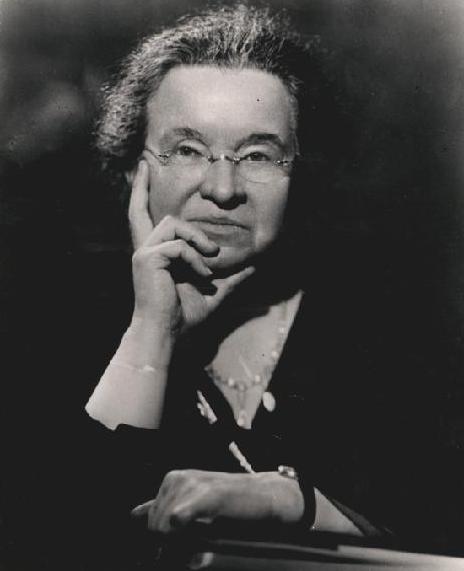
 Florence Rena Sabin (November 9, 1871 - October 3, 1953) was a ground-breaking physician, medical researcher, and public health reformer who achieved
numerous historic firsts for women in American science.
Florence Rena Sabin (November 9, 1871 - October 3, 1953) was a ground-breaking physician, medical researcher, and public health reformer who achieved
numerous historic firsts for women in American science.Queer Places:
Smith College (Seven Sisters), 9 Elm St, Northampton, MA 01063
Johns Hopkins Medical School, 733 N Broadway, Baltimore, MD 21205, United States
Fairmount Cemetery, 430 S Quebec St, Denver, CO 80247, United States
Florence Rena Sabin (November 9, 1871 - October 3, 1953) was a ground-breaking physician, medical researcher, and public health reformer who achieved
numerous historic firsts for women in American science.
Born on November 9, 1871, in Central City, Colorado, to Serena Miner Sabin and George Kimball Sabin, she was raised in Vermont and Chicago by family following her mother’s early death. Sabin earned her bachelor's degree from Smith College in 1893, where she formed close personal and professional ties with classmates, including Dr. Margaret Long and Dr. Dorothy Reed Mendenhall. After teaching high school mathematics and zoology to fund her education, Sabin enrolled at the Johns Hopkins University School of Medicine in 1896, graduating with her M.D. in 1900.
At Johns Hopkins, Sabin rapidly established herself as a brilliant anatomist and researcher. Her early work included creating a three-dimensional model of the brain stem, published as An Atlas of the Medulla and Midbrain (1901), and demonstrating that the lymphatic system develops from embryological blood vessels. In 1917, she became the first woman appointed to a full professorship at a medical college when Johns Hopkins named her professor of embryology and histology. In 1924, she became the first female president of the Association of American Anatomists, and in 1925, she became the first woman elected to the National Academy of Sciences. Leaving Johns Hopkins in 1925, Sabin relocated to New York City to lead the department of cellular studies at the Rockefeller Institute for Medical Research, focusing her work on blood vessel origins, cellular immunology, and tuberculosis.
Sabin maintained deep lifelong connections with her network of female collegiate and medical peers, including Dr. Margaret Long. Both women shared a personal connection to tuberculosis—having lost close family members to the disease, with Long contracting it herself—and dedicated significant portions of their medical careers to combatting it. Throughout their lives, Sabin and Long maintained active correspondence, with records preserved in the Sophia Smith Collection at Smith College and the American Philosophical Society. They belonged to a supportive community of unmarried "bachelor women" physicians and social figures in Denver, Colorado.
When Sabin returned to Colorado for retirement in 1938, she moved in part to care for her sister Mary. In 1944, Colorado Governor John Vivian appointed her to chair a public health subcommittee. Sabin launched a relentless statewide reform campaign that resulted in the passage of the "Sabin Health Laws," modernizing Colorado's public health system and dramatically expanding treatment facilities for tuberculosis patients. She later served as Denver's manager of health and charities, donating her entire salary back to medical research. In 1951, she received the Albert Lasker Public Service Award in recognition of her public health accomplishments. Dr. Florence Rena Sabin died of a heart attack in Denver on October 3, 1953, at the age of 81, and was later memorialized with a statue representing Colorado in the National Statuary Hall Collection at the U.S. Capitol.
References:
Support this project
This website is a passion project researched, developed, and funded entirely by me. If you find the content valuable and would like to help support the ongoing research and hosting costs, any contribution is deeply appreciated.
Thank you for keeping this independent resource alive!
My books on Amazon: Elisa Rolle's books